
The Nikkei Markit India Manufacturing Purchasing Managers' Index (PMI) -- an indicator of manufacturing activity -- declined from 52.5 in April to a three-month low of 51.6 in May.

These schemes will be based on enrolment in Employees' Provident Fund Organization (EPFO), Sitharaman said in the Lok Sabha.

Geopolitical developments between India and Pakistan, quarterly earnings and macro data will be the key drivers of stock markets in the holiday-shortened week, say analysts.

The BYD Sealion 7 offers instant, exhilarating power, effortlessly pinning you to your seat with a 0-100 km/h sprint in just 4.5 seconds -- a performance proudly showcased on its rear badging.
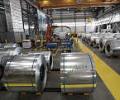
Recent reform measures announced by the government expected to boost the sector.

The HSBC India Manufacturing Purchasing Managers' Index -- a measure of factory production -- stood at 54.7 in December, up from 53.7 in November, indicating a further improvement in the health of the Indian manufacturing sector.

India's industrial production growth slipped to 3-month low of 5 per cent in April 2024, mainly due to poor show by the manufacturing sector, though mining and power segments performed well, according to official data released on Wednesday. Factory output growth, measured in terms of the Index of Industrial Production (IIP), was 5.4 per cent in March and 5.6 per cent in February 2024. The previous low of IIP was recorded at 4.2 per cent in January, 2024.

Despite the alarming figures on job displacement, AI is expected to generate millions of new roles, echoing historical trends of technological transformation.
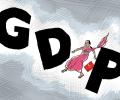
India's economic growth slowed down to 4.4 per cent in the third quarter of 2022-23 mainly due to poor performance of the manufacturing sector. In October-December 2021, the economy grew by 11.2 per cent and by 6.3 per cent in the July-September 2022 quarter, according to data released by the National Statistical Office (NSO) on Tuesday.

India's largest cable and wire manufacturer Polycab India ended financial year 2024-25 (FY25) on a high, delivering another strong quarter of double-digit growth and market share gains. This coupled with margin expansion, operating breakeven for its fast-moving electrical goods (FMEG) business, and steady exports outlook for FY26 is expected to support the stock, which is up 18 per cent over the past month. The stock is currently trading at Rs 5,765 a share.

The HSBC India Manufacturing Purchasing Managers' Index (PMI) - a measure of factory production - improved slightly to 55 in June, from 54.8 in May.
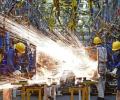
The headline seasonally adjusted IHS Markit India Manufacturing Purchasing Managers' Index (PMI) fell to 27.4 in April, from 51.8 in March, reflecting the sharpest deterioration in business conditions across the sector since data collection began over 15 years ago. The index slipped into contraction mode, after remaining in the growth territory for 32 consecutive months. In PMI parlance, a print above 50 means expansion, while a score below that denotes contraction.

The services sector growth in India rose to a three-month high in December supported by favourable economic conditions and positive demand trends, a monthly survey said on Friday. The seasonally adjusted HSBC India Services PMI Business Activity Index rose from 56.9 in November to 59 in December, highlighting a sharp increase in output that was the most pronounced since September. In Purchasing Managers' Index (PMI) parlance, a print above 50 means expansion while a score below 50 denotes contraction.

Reserve Bank on Wednesday cut India's growth forecast to 6.5 per cent from 6.7 per cent estimated earlier for the current financial year on account of impact of global trade and policy uncertainties. Prospects of agriculture sector remain bright on the back of healthy reservoir levels and robust crop production in 2025-26, RBI Governor Sanjay Malhotra said while unveiling the outcome of the first bi-monthly Monetary Policy Committee meeting for the current financial year.

Private sector engineering major Larsen & Toubro has said that China is systematically killing Indian manufacturing sector and sought 25 per cent anti-dumping duty on Chinese goods.

'It's important for India to think about areas where it wants the US to move.' 'We can be far more innovative in what we ask the US.' 'Given that there's a package deal, why not do it?'

In today's dynamic economic landscape, commerce and management education is crucial for a global career, says Nayagam PP.

Vi partners SpaceX-rival AST SpaceMobile for satcom service on smartphones

India successfully intercepted or neutralized all Pakistani missiles and drones that targeted 15 Indian cities on Wednesday night, according to official sources. The attack, which was launched in response to India's Operation Sindoor, involved the deployment of Barak-8 missiles, S-400 Triumph air defense systems, Akash surface-to-air missiles, and indigenously developed anti-drone equipment. India retaliated with precision strikes on Pakistani territory, destroying an HQ-9 air defense unit in Lahore and damaging key radar infrastructure. The incident highlights the strength of India's air defense capabilities and its ability to project power with surgical precision.

A Reuters report stated that the high-profile meeting reflects Ambani's growing influence in global business and diplomacy. Over the years, Qatar Investment Authority (QIA), the country's sovereign wealth fund, has invested in several Reliance ventures.

rediffGURU Patrick Dsouza, founder of Patrick100 counsels students, and aspiring professionals about the scope of an MBA degree.

The US retaliatory tariffs are a major setback for the Indian gems and jewellery exports, apex industry body GJEPC said on Thursday as it urged the government to take steps to secure the long-term interest of the sector. The US has announced 27 per cent reciprocal tariffs on India saying New Delhi imposes high import duties on American goods, as the Donald Trump administration aims to reduce US' trade deficit and boost manufacturing.
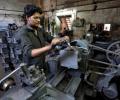
India's industrial production output decelerated to 4.8 per cent year-on-year in July 2024, mainly due to poor performance of the manufacturing and mining sectors, as per official data released on Thursday. The factory output growth, measured in terms of the Index of Industrial Production (IIP), was revised to 4.7 per cent in June from provisional estimates of 4.2 per cent released last month. The IIP for July 2024 was 4.8 per cent, as per the data.

The index, however has remained above the 50 mark - below which it indicates contraction - for more than three years now.
India's manufacturing sector growth improved in November, registering the fastest pace in five months, driven by a strong pick up in new orders and improved purchasing activity, an HSBC survey said on Monday.

The initial public offering (IPO) lane will be busy next week, with four main-line companies, including Leela Palaces Hotels & Resorts operator Schloss Bangalore Ltd and Aegis Vopak Terminals tapping the primary market to raise over Rs 6,600 crore collectively.

The services sector growth in India rose to a six-month high in January as new business expanded at a faster pace amid buoyant demand from domestic and external clients, a monthly survey said on Monday. The seasonally adjusted HSBC India Services PMI Business Activity Index rose to 61.8 in January, up from 59 in December, pointing to the sharpest rate of expansion in six months.

India's indigenously developed 'Akashteer' air defense system performed exceedingly well during 'Operation Sindoor,' according to Defence Research and Development Organisation (DRDO) chief Samir V Kamat. The fully automated system, deployed against terror sites in Pakistan and Pakistan-occupied Kashmir, integrates various radar systems, sensors, and communication technologies. Kamat expressed confidence in the system's success drawing international interest, highlighting India's progress toward self-reliance in the defense sector. He also addressed the future of warfare, emphasizing the need for a blend of traditional and emerging technologies, and outlined the development timeline for the indigenous 5.5-generation stealth fighter aircraft, the Advanced Medium Combat Aircraft (AMCA).

From the Sensex firms, Reliance Industries, Tech Mahindra, Eternal, HCL Tech, Infosys, IndusInd Bank, Tata Consultancy Services and Bajaj Finserv were the biggest gainers. In contrast, UltraTech Cement, Sun Pharma, Power Grid, NTPC, Kotak Mahindra Bank and Mahindra & Mahindra were among the laggards.
Three manufacturing sectors (engineering and construction, industrial commodities and materials and commodities) created more value for its shareholders in last five years than IT or pharmaceutical companies. Engineering and construction companies, led by Larsen & Toubro and BHEL, posted a total shareholder return of 81 per cent in the last five years trailing March 31, 2007, the BCG-CII study showed.

India should convert the Trump threat to an India opportunity, re-embracing a more liberal trade regime as a way of reviving manufacturing output and exports.

Industry insiders in India warn that any such move in the pharmaceutical sector could be counterproductive for the US as it may face increased drug shortages if tariffs are imposed on such imports.

'As the global economy undergoes significant transformations in 2025, India's ability to navigate the complexities of trade wars, financial realignments, and emerging blocs will be pivotal,' explain Harsh V Pant and Soumya Bhowmik.

The time is ideal for a 'Dream Budget' akin to the 1991 reforms that sparked high growth and unlocked significant gains in productivity, points out Rajeswari Sengupta.

'Entering India is exciting, but it's also challenging. You have to be prepared for long-term investment.'

Commerce and Industry Minister Piyush Goyal on Thursday asked the Indian startup community to shift their focus from grocery delivery and ice cream making to to high tech sector like semiconductor, machine learning, robotics, and artificial intelligence. He also said there is a need for more Indian investors into the startup ecosystem.

After a gap of nearly two years, India's industrial production turned negative as it contracted by 0.1 per cent in August, mainly due to a decline in the mining and power generation sectors' output, in addition to an almost flat expansion in the manufacturing sector. According to the data released by the National Statistical Office (NSO), factory output growth based on the Index of Industrial Production (IIP) has also been revised downwards for July to 4.7 per cent from the earlier estimate of 4.8 per cent. "The IIP growth rate for the month of August 2024 is (-) 0.1 per cent, which was 4.7 per cent in the month of July 2024," NSO said in a release.

Institutional investments in Indian real estate have seen a strong start to 2025, with inflows reaching $ 1.3 billion in the first quarter - a 31 per cent year-on-year (YoY) increase. This growth was primarily driven by domestic investments, which accounted for 60 per cent of the total inflows during the quarter. With $ 0.8 billion inflows, domestic investments saw a 75 per cent annual rise and were largely focused on industrial & warehousing and office segments.

India fully utilised its military modernisation budget in 2024-2025 -- the first time in five years -- and signed a record Rs 2 trillion defence contracts.

The company had announced similar pricing for Sri Lanka, where its application was in advanced stages of regulatory clearance.
